poetry in action features work by poets from around the world, translated into English.
NOW MORE THAN EVER:
Poets of the world, unite and take over!
Resist the oppressive constraints of good, publishable poetry established by mainstream literary venues!
Only poetry in translation, all the time!
Coming at you around the 20th of each month.
Selections from Goethe’s Faust
Translated from the German by Hannah V Warren
///
Translator’s Note
Germany’s late eighteenth-century Sturm and Drang movement is characterized by violence, emotional turbulence, and a bit of madness, a description that perfectly encapsulates Goethe’s Faust. In my translation, I aim to discover what will happen if I keep these tenets while stripping the text of masculine figures and interrogating how translation can undercut gendered language as a praxis. In other words, I want to embrace feminine violence through the historical lens of Goethe’s religious melodrama.
As a gendered language, German’s declensions create meaning, and I’ve fiddled with these linguistic differences. For example, when Goethe writes, “Wenn dich in Schlachten Feinde drängen,” he reaches for masculine aggressors and the language of war (f.). Many Faust translators maintain this war-centric metaphor: “When enemies jostle you” (Kline 2003), “When foes in combat sorely press you” (Taylor 2005), and “When adversaries threaten battle” (Ozsvàth & Turner 2020). My translation—“when the butcher teaches you slaughter”—evades war and gender but still embraces violence. On a quirkier note, I had great fun with the phrase “Mit Muth and Anmuth.” Generally, you’d stick with something like “with boldness and charm,”, but Mut (m.) also carries a slang for testicles. The prefix An- serves to make the word feminine, softening the definition to include charm and loveliness. In other words, the line could read “with enormous balls and grace.” I chose “with elegance & a clit of steel.” Here, I’m pursuing excess while also stretching my translation practice.
Contextual Note
In Faust’s prologue, a director, poet, and comedian argue about how they should structure their play. The director proposes putting together a slapdash spectacle full of visual delights so everyone will leave satisfied. The poet bemoans a lack of craft. The comedian suggests they create a play that incorporates a bit of everything while still relying on poetic virtues.
///
Poet
Go find yourself another goosegirl!
Should the poet forfeit the highest right—
her Nature-granted right!
—so you might fill your pockets?
How will she move the heart again?
How will she maneuver every element?
Isn’t it sympathy that emanates from her flesh
& draws the world back into her heart?
When Nature’s never-ending thread unravels,
cramping apathetically on the spindle,
when the tone-deaf hordes
all petulantly bang together,
who forces chaos into rhythm?
Who hums a calming lullaby?
Who calls the individual to simultaneous worship?
Who bids the passionate storm to rage
& chime wonderful chords?
The sunset to create a sober evening glow?
Who scatters all the delicate spring blossoms
over our beloved’s meandering paths?
Who weaves laurel wreaths
& honors lovely work in every art?
Who preserves Olympus? Unites the gods?
The poet reveals a human’s power.
Comedian
Okay, so our audience wants a striking narrative
to motivate the play’s poetic concerns,
just as one pursues her lover—let’s use that!
Picture it: by chance, two come together—
they stay &, little by little, their hearts intertwine.
They fall in love, then comes turmoil.
They’re enraptured, then comes pain.
And before you know it, we have a romance novel.
We can produce such a play!
Just squeeze the fullness of human life!
Everyone lives, but not many recognize life,
& life is riveting, no matter the packaging.
We can brew the finest draught
of flamboyant metaphors, a stack of fallacies,
only a pinch of clarity, & a spark of truth—
we’ll revitalize the world!
Our finest youth will congregate
for your play & harken to the revelation.
Every tender mind will take
melancholy nourishment from your work.
Then, so very soon, everyone will see
what they carry in their hearts.
They’re readily moved to both weeping & laughter.
They still honor momentum, delight in illusions;
the wizened cannot be pleased,
but the young will always be satisfied.
Poet
So give me back the days
when I was still on the verge of becoming,
when my wellspring of language
spilled forth, each word born anew,
when fog veiled the world from me,
when the budding strawberry still promised wonders
& I bit into the thousand fruits
overflowing every valley.
I had nothing & yet enough—
a compulsion for truth & lust for illusion.
Give me back those untamed instincts,
that deep, painful joy,
the strength of hatred, the power of love—
give me back my youth!
Comedian
Youth, my dear friend, is what you need most
when the butcher teaches you slaughter,
when a lover clings to your hips
with gentlebruising fingers,
when the laurel wreath beckons
far beyond the marathon’s finish line,
when you spend your nights gorgeously drunk
after the fierce whirl of dancing.
But to work those familiar harpstrings
with elegance & a clit of steel,
to ramble madly toward
a self-imposed ambition—
my dear, that is your complete obligation,
& we admire you no less for it.
Growing old doesn’t make us childish again,
as they claim—it finds that we’re still children.
///
Dichter
Geh hin und such dir einen andern Knecht!
Der Dichter sollte wohl das höchste Recht,
Das Menschenrecht, das ihm Natur vergönnt,
Um deinetwillen freventlich verscherzen!
Wodurch bewegt er alle Herzen?
Wodurch besiegt er jedes Element?
Ist es der Einklang nicht? der aus dem Busen dringt,
Und in sein Herz die Welt zurücke schlingt.
Wenn die Natur des Fadens ew’ge Länge,
Gleichgültig drehend, auf die Spindel zwingt,
Wenn aller Wesen unharmon’sche Menge
Verdrießlich durch einander klingt;
Wer theilt die fließend immer gleiche Reihe
Belebend ab, daß sie sich rythmisch regt?
Wer ruft das Einzelne zur allgemeinen Weihe?
Wo es in herrlichen Accorden schlägt,
Wer läßt den Sturm zu Leidenschaften wüthen?
Das Abendroth im ernsten Sinne glühn?
Wer schüttet alle schönen Frühlingsblüten
Auf der Geliebten Pfade hin?
Wer flicht die unbedeutend grünen Blätter
Zum Ehrenkranz Verdiensten jeder Art?
Wer sichert den Olymp? vereinet Götter?
Des Menschen Kraft im Dichter offenbart.
Lustige Person
So braucht sie denn die schönen Kräfte
Und treibt die dicht’rischen Geschäfte,
Wie man ein Liebesabenteuer treibt.
Zufällig naht man sich, man fühlt, man bleibt
Und nach und nach wird man verflochten;
Es wächst das Glück, dann wird es angefochten,
Man ist entzückt, nun kommt der Schmerz heran,
Und eh man sich’s versieht ist’s eben ein Roman.
Laßt uns auch so ein Schauspiel geben!
Greift nur hinein ins volle Menschenleben!
Ein jeder lebt’s, nicht vielen ist’s bekannt,
Und wo ihr’s packt, da ist’s interessant.
In bunten Bildern wenig Klarheit,
Viel Irrthum und ein Fünkchen Wahrheit,
So wird der beste Trank gebraut,
Der alle Welt erquickt und auferbaut.
Dann sammelt sich der Jugend schönste Blüte
Vor eurem Spiel und lauscht der Offenbarung,
Dann sauget jedes zärtliche Gemüthe
Aus eurem Werk sich melanchol’sche Nahrung;
Dann wird bald dies bald jenes aufgeregt,
Ein jeder sieht was er im Herzen trägt.
Noch sind sie gleich bereit zu weinen und zu lachen,
Sie ehren noch den Schwung, erfreuen sich am Schein;
Wer fertig ist, dem ist nichts recht zu machen,
Ein Werdender wird immer dankbar seyn.
Dichter
So gieb mir auch die Zeiten wieder,
Da ich noch selbst im Werden war,
Da sich ein Quell gedrängter Lieder
Ununterbrochen neu gebar,
Da Nebel mir die Welt verhüllten,
Die Knospe Wunder noch versprach,
Da ich die tausend Blumen brach,
Die alle Thäler reichlich füllten.
Ich hatte nichts und doch genug,
Den Drang nach Wahrheit und die Lust am Trug.
Gieb ungebändigt jene Triebe,
Das tiefe schmerzenvolle Glück,
Des Hasses Kraft, die Macht der Liebe,
Gieb meine Jugend mir zurück!
Lustige Person
Der Jugend, guter Freund, bedarfst du allenfalls
Wenn dich in Schlachten Feinde drängen,
Wenn mit Gewalt an deinen Hals
Sich allerliebste Mädchen hängen,
Wenn fern des schnellen Laufes Kranz
Vom schwer erreichten Ziele winket,
Wenn nach dem heftgen Wirbeltanz
Die Nächte schmausend man vertrinket.
Doch ins bekannte Saitenspiel
Mit Muth und Anmuth einzugreifen,
Nach einem selbgesteckten Ziel
Mit holdem Irren hinzuschweifen,
Das, alte Herrn, ist eure Pflicht,
Und wir verehren euch darum nicht minder.
Das Alter macht nicht kindisch, wie man spricht,
Es findet uns nur noch als wahre Kinder.
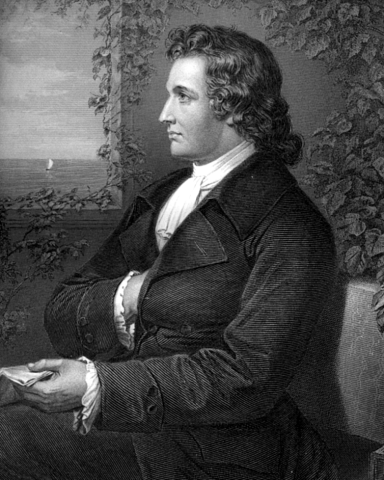
Johann Wolfgang von Goethe (1749–1832) was a German writer, poet, dramatist, and thinker central to European Romanticism and Classicism. Author of Faust, he explored nature, art, and self-formation, combining literary genius with scientific inquiry and a lifelong commitment to intellectual wholeness.
Hannah V Warren is a poet, translator, and scholar. Along with authoring the poetry collections Hurricane Pastoral (Sundress 2027) and Slaughterhouse for Old Wives’ Tales (Sundress 2024), she has received support from Fulbright-Germany, the PEN/Heim Translation Grant, the Kenyon Review fellowship, and the Foundation for Contemporary Arts.