poetry in action features work by poets from around the world, translated into English.
NOW MORE THAN EVER:
Poets of the world, unite and take over!
Resist the oppressive constraints of good, publishable poetry established by mainstream literary venues!
Only poetry in translation, all the time!
Coming at you around the 20th of each month.
 Four poems by Nakahara Chūya from the forthcoming Angel at the Earth’s Extreme, available for pre-order!
Translated from the Japanese by Jeffrey Angles
///
Translator’s Note
In almost every country, there are poets who have left such an enormous mark on their nation’s literature that virtually all young lovers of literature inevitably devour it. Some poets make their mark exclusively through writing alone, but others also led such interesting and dramatic lives that their names accrue a special, even hagiographic mythos. In Japan, Nakahara Chūya was one such poet: a brilliant, emotive, driven writer who produced a remarkable, unique body of work before dying of tuberculosis at the age of thirty.
Although he started off by writing tanka, a form of traditional verse that has more than thirteen centuries of history, Chūya was one of the earliest generations of Japanese poets influenced by Dadaism and other newly introduced forms of Western avant-garde modernism. This gave him an unusually large poetic vocabulary, both classical and modern, to work with, and over the course of this life, he combined these in various ways to produce an astonishingly fresh body of work.
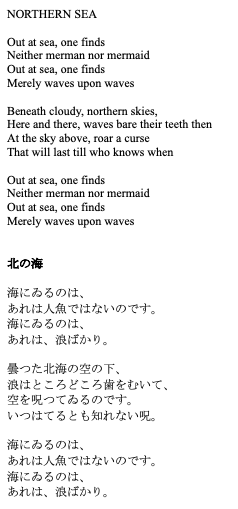
Moreover, Chūya developed a passionate interest in French poetry, especially that of Arthur Rimbaud whose work he translated and published in three volumes during the 1930s. Like Rimbaud and the other poètes maudits, Chūya routinely writes poems that reflect a profound sense of ennui and angst. After growing up in a military family and repeatedly clashing with his father who was a doctor in the military, Chūya developed a strong distrust of authority, politics, and the police. Given this, his world-weary attitude might be read at least in part as a reaction to the nationalistic turn Imperial Japan was taking during the era in which Chūya lived. For instance, the poem “Northern Sea” included below presents a stark vision of an empty sea devoid of life—a vision that profoundly different than that espoused by the Japanese navy at a moment when it was busily transforming itself into an aggressive military force.
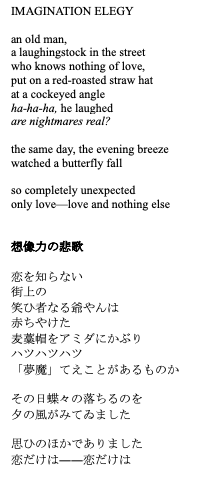
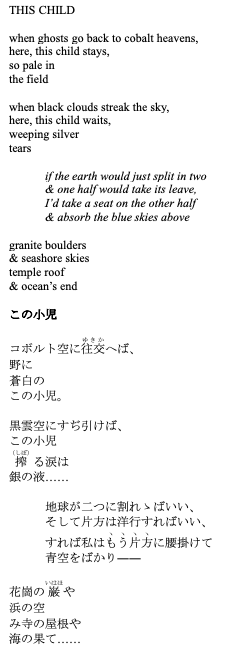
The first two poems below display Chūya’s interest in modernism, whereas the second two demonstrate the ways that, in his final collection especially, he developed a stark, modern, colloquial voice that combines unusual images and repeated patterns to produce poems that linger in the imagination long after reading.
///
NAKAHARA Chūya 中原中也 (1907-1937) is one of the most beloved Japanese poets of the twentieth century. He was one of the first generation of poets in Japan to incorporate elements of Dadaism and other elements of modernism alongside traditional elements of Japanese verse. He produced two poetic collections in his lifetime, Songs of the Goat and Songs of Days that Were, which display his own unique brand of ennui and increasingly romantic melancholy. He died prematurely at age thirty due to tuberculosis. The largest selection of his work in English is available in Nakahara Chūya, Angel at the Earth’s Extreme, translated by Jeffrey Angles (Penguin Classics, 2026).
Jeffrey ANGLES ジェフリー・アングルス (born 1971) is a poet, translator, and professor of Japanese literature at Western Michigan University. When he was a teenager, he lived in Yamaguchi, near the home of the modernist, avant-garde poet Nakahara Chūya, thus leading to his fascination for this important poet, which culminated in the publication of Chūya’s collected works: Angel at the Earth’s Extreme (Penguin Classics, 2026). Among his many other translations are four volumes of the radical feminist poet Hiromi Ito: Killing Kanoko (Action Books, 2009), Wild Grass on the Riverbank (Action Books, 2014), The Thorn Puller (Stone Bridge Press, 2022), and Coyote Song (Action Books, forthcoming). His own book of Japanese-language poetry was a finalist for the Nakahara Chūya Prize and won the Yomiuri Prize.