
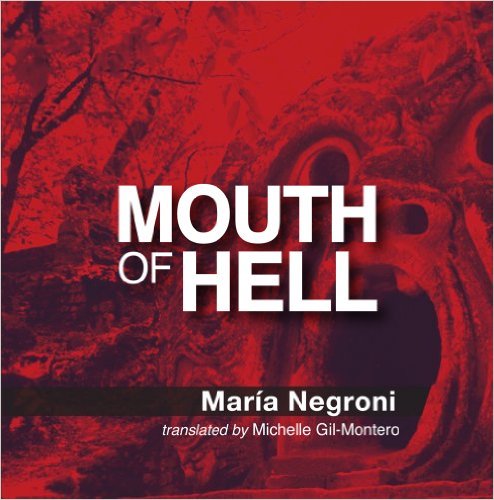
Mouth of Hell, by María Negroni
I’m a big fan of all three works that Action Books has published by Negroni (this book, Dark Museum, and The Annunciation—for which I wrote a book review at Tarpaulin Sky), and it was difficult to choose just one for the stock room pick since I like all three so much (and all three are brilliantly translated by Michelle Gil-Montero). But I decided on Mouth of Hell because I think it highlights Negroni’s particular style of experimental Gothicism. The book, a series of brief, untitled poems, is simultaneously a conjuring-up of Pier Francesco Orsini’s voice as he journeys through his Sacred Grove of Bomarzo and a Borgesian work of intertextuality, playing off both the historical Orsini and the fictional one created by Mujica Láinez in his novel Bomarzo. An explorer of Art as a masque that evokes the stranger/wilder Mysteries, Negroni’s Orsini is part Wildean and part Dantean, a Symbolist of the underworld. “In this live pandemonium,” Negroni’s Orsini says, “specters dance, motionless monsters trade terrible gazes with no one…Now and again, from a lascivious earth to an uncertain beyond, the thread of my hallucinated life.” Though Negroni’s Mouth of Hell might be a short poetry collection, it contains many shadowy multitudes.
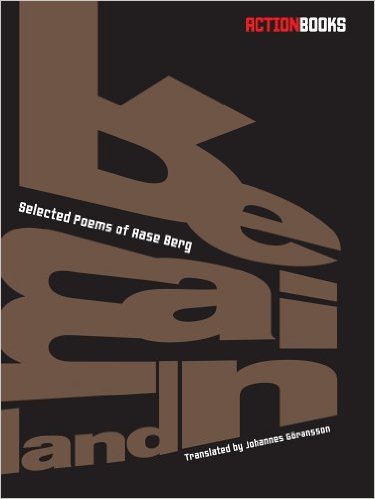
Remainland, by Aase Berg (Now out of print – but you can purchase many Aase Berg titles from Black Ocean)
I first read some of Johannes Göransson’s translations of Berg’s work in grad school—I especially remember reading “In the Heart of the Guinea Pig Darkness”—and it really did seem incredibly different from most of the poetry being written in the States in the late 90s. The artful grotesquerie, and the manic cross-pollination between sci-fi and horror and folk tales, spoke of a thorny poetic sensibility that was drawn less to epiphanies than to intensities. So I was very excited when Remainland, selected poems by Berg translated by Johannes, was published. And though it came out a little over twenty years ago (!), Remainland is still one of my favorites from Action Books. The poems veer from churning cosmic materialism (“does the hare’s time-space disappear / into the fetusfat’s All, the / tight conclusive One”) to polluted terrain-zones (“Lemurs shimmering radiation blue”) to nightmare fairytale (“…and now I finally roll out your guinea-pig body on the baking sheet”), with Berg’s coiled-spring phrasing and wordplay cranking up the tension even further. Remainland is like a leaky, scintillating artifact from the future.

The Trilogy, by Bruno K. Öijer
The Trilogy captivated me when I first read it, and it’s a title I keep returning to again and again because of its electric uncanniness, and its mercurial voice that is by turns contemplative and sardonic, nostalgic and acerbic, elegiac and vision-seeking. The title refers to a trilogy of Öijer’s books—While the Poison Acts, The Lost Word, and The Fog of Everything—that, as Johannes Göransson explains in his excellent introduction, became (and continues to be) hugely popular and influential in Sweden. The translation of those works for Action’s The Trilogy was a collaboration between the poet, the translator Victoria Haggblom, and Action Books editors. In this work, the borders between memory, dream and the fantastical are porous, with the light of one casting its glow on the others. In poems like “The Secret Room,” the poet purposely drifts outside of the self, becomes a ghost to himself. “You open the secret door / to your room,” Öijer writes, “and sneak up on yourself…to study your own sleeping face.” This is poetry as séance, a tenebrous lyricism that not only describes the spectral but channels it.

Pop Corpse, by Lara Glenum
I strongly associate Action Books with Lara Glenum’s work. Her The Hounds of No, one of Action’s first titles, is an aesthetic/poetic amphetamine. And her 2013 collection Pop Corpse is, as with all of Glenum’s work, strikingly original. I love its stylistic boldness—its play-format that keeps erupting into monologues and emoticons and feverish stage directions—and also its exploration of all the registers of the monstrous. In this collection, the monster is freed from its rigid, negative connotations to become a riotous assemblage of visceral possibility. With characters (voices) like “Cinderskella,” “XXX,” and “Blubber Socket,” Pop Corpse makes the disgusting sublime and the sublime disgusting. The book opens with a vista of “no land. Only floating islands of plastic garbage,” and ends with “a grime art cell. A rouge art collective…cannibalizing themselves in2 art.” Between those poles, Glenum’s work is boiling slipstream of blistering rage and acidic joy.

James Pate is a fiction writer and poet. He is the author of The Fassbinder Diaries (Civil Coping Mechanisms), Flowers Among the Carrion (Action Books), and the occult crime novel Speed of Life (Fahrenheit Press). His latest poetry collection Mineral Planet is available from Schism Press. He has had work published in Black Warrior Review, Aphotic Realm, Berkeley Fiction Review, Coffin Bell, Occulum, Ligeia, storySouth, Pembroke Magazine, Superstition Review, and Deracine: A Gothic Literary Journal, among other places.